
Choose by seating layout, speaking rules and the complete audio path—not microphone count alone. Compare cable access with wireless charging and RF requirements. For remote participants, confirm two-way audio and echo control before accepting a quotation.
01 / Define how the meeting works
A discussion system manages who speaks from a seat. A video-conferencing platform connects remote participants. Some projects need both; neither automatically replaces the other.
Boardrooms
Prioritize clear conversation, repeatable operation and the room’s remote-call workflow.
Council rooms
Define chairperson priority, speaking requests and any recording or voting requirements.
Flexible venues
Check reconfiguration time, storage, charging and who prepares each meeting.
Write down seat count, simultaneous speakers, meeting duration and required functions. Voting, interpretation, camera tracking and recording must be confirmed for the quoted model and configuration—not assumed from the term “digital conference system.”
Background: Shure’s discussion-system overview.
02 / Wired or wireless? Compare the daily work.
Neither approach is automatically better sounding or more reliable. Installation quality, room conditions and the selected system matter.
| Project condition | Wired: check this | Wireless: check this |
|---|---|---|
| Permanent seating | Furniture cable routes and service access. | Whether layout flexibility justifies charging tasks. |
| Changing layouts | Reconnection time and cable protection. | Coverage at every proposed seat position. |
| Long sessions | Controller power and permitted cable lengths. | Verified runtime, charging windows and spares. |
| Site conditions | Connectors, topology and installation constraints. | RF survey, permitted regional frequencies and coexistence. |
| Total cost | Cabling, installation, commissioning and service. | Chargers, batteries, storage and ongoing maintenance. |
Decision context: CREATOR’s project-selection guide. These are planning checks, not a guarantee for any model.
03 / Check the system—not just the microphone
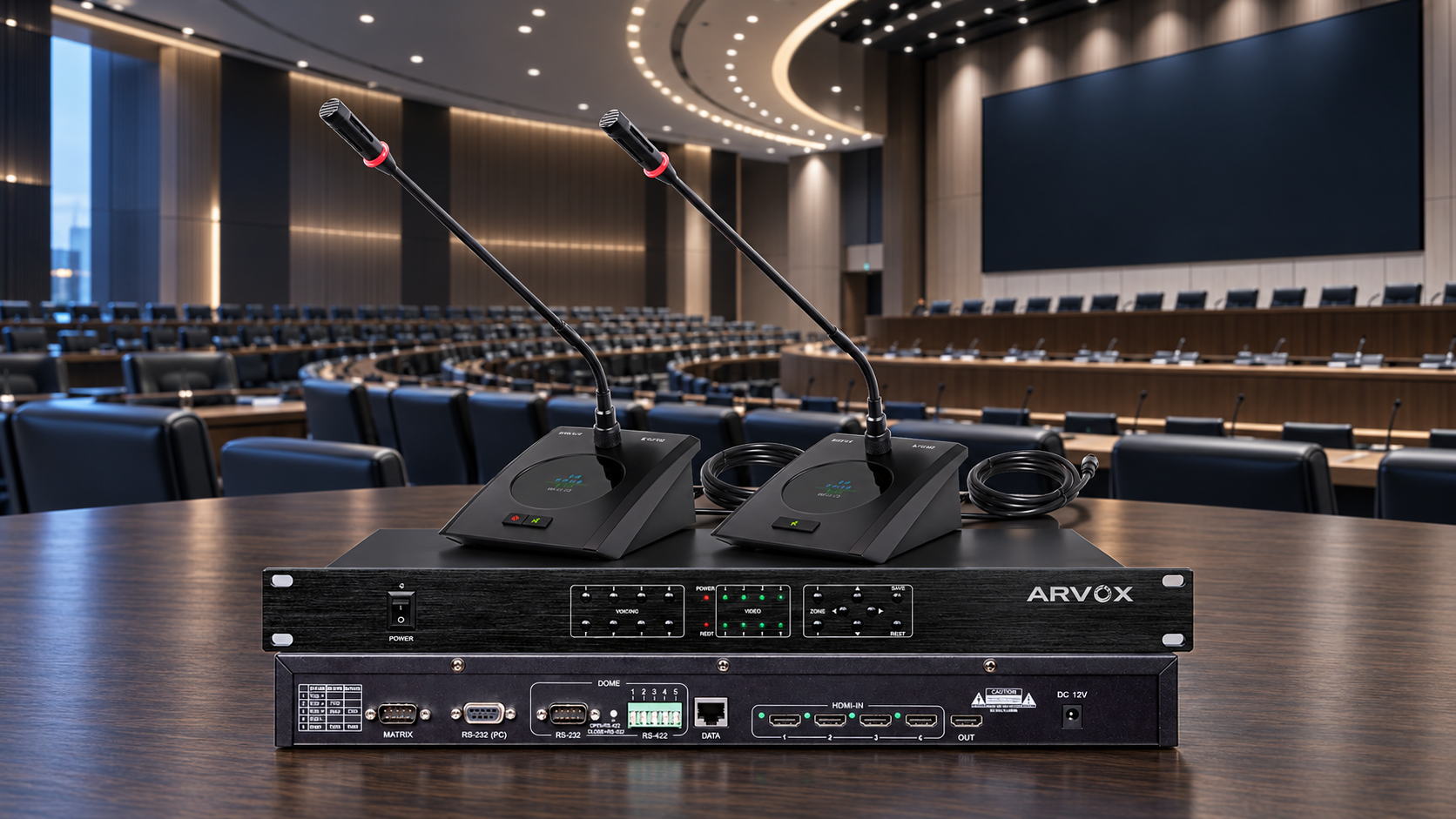
Confirm speaking controls, indicators and how participants hear the discussion.
Check compatible units, expansion, cable limits or wireless access points.
Assess microphone placement, acoustics and whether local reinforcement is needed.
List interfaces, software licences and any hardware required for each requested feature.
Connector shape is not proof of compatibility. Do not mix controllers and discussion units solely because the plugs fit. Ask for a documented compatibility list and a complete equipment schedule.
Explore ARVOX conference systems and request model-specific documentation before shortlisting.
04 / Give remote participants a complete audio path
A USB socket or network port alone does not prove a system is ready for your meeting platform. Confirm what it carries and which interface is required.
Conceptual signal flow—not wiring instructions. Processing may be integrated or external.
Acoustic echo cancellation (AEC) addresses remote speech picked up again by room microphones. Mix-minus routing avoids returning a participant’s own audio through the call. Ask the integrator to identify where these functions operate and test both directions; do not assume they are built into every controller.
Technical references: Shure on conferencing DSP and Biamp on mix-minus design.
05 / Separate seat count from speaking capacity
Consider an illustrative 12-seat boardroom with fixed furniture, one chairperson and remote attendees. This is a planning exercise—not an ARVOX customer case or a finished bill of materials.
If the brief allows three delegates to speak together, ask whether the chairperson uses an additional active channel or is included in that limit. Confirm request-queue behaviour, priority and expansion with the quoted controller. Twelve connected units do not establish how many microphones can be active simultaneously.
Ask for a demonstration, not just a feature list
- Activate the agreed number of microphones and test chairperson intervention.
- Listen from the far end of a real call while people speak and interrupt naturally.
- Test every intended seat, the full meeting duration and the recovery procedure.
- Confirm the promised recording or camera behaviour only if included in the quote.
06 / Make supplier quotations comparable
Distributors and integrators should send the same brief to each shortlisted supplier. Compare the complete delivered system, including accessories, commissioning and support.
- Room: floor plan, dimensions, photos and seating layouts.
- Operation: chairperson roles, speaking rules and meeting duration.
- Integration: remote platform, existing audio, recording and optional functions.
- Delivery: country, quantity, budget, timeline, warranty and spare-unit needs.
Planning a conference project with ARVOX?
Send your room plan and completed brief to gloria@arvox-tech.com. Request a model-specific proposal with inclusions, exclusions and an acceptance-test plan.
Need building-wide announcements as well? Read our public address system selection guide.
Common buyer questions
Does every seat need its own microphone?
Not always. Dedicated units suit individual speaking control; shared microphones may suit other layouts. Check microphone reach, pickup, accessibility and operating rules rather than assigning one unit by default.
Can a wireless system handle an all-day meeting?
Potentially. Verify the selected model’s runtime under the intended conditions, charging turnaround, spare batteries or units, and the site’s wireless environment.
Can I connect the system to Teams or Zoom?
Only after confirming the audio interface, routing and processing for the proposed setup. A product’s digital or IP label is not proof of platform certification or direct compatibility.
Are interpretation and voting included?
Not necessarily. Specify languages, participant roles and workflow, then verify the necessary hardware, licences and model capabilities in the quotation.
Sources & scope
Prepared from the manufacturer references linked above, checked 16 September 2026. The diagrams and example brief are explanatory, not an installation design. Third-party references do not imply endorsement. This draft requires model-level confirmation before any purchasing recommendation.