Choose a professional sound system around the audience area, programme material and operating needs—not advertised watts alone. Check coverage and usable output, choose a powered or passive architecture, then confirm processing, cabling, installation and commissioning as one complete package.
01 / Start with the venue, not a speaker size
This guide covers sound reinforcement for speech and music. Building-wide paging and managed meeting discussion are different buying tasks: see our public address guide and conference microphone guide.
Multipurpose halls
Plan for presentations, performances and changing seating layouts.
Hospitality venues
Balance music, announcements, room acoustics and nearby spaces.
Portable events
Include transport, setup time, power access and outdoor exposure.
Record room dimensions, ceiling height, audience depth, reflective surfaces and mounting constraints. Add the actual programme: speech, acoustic music, amplified bands or DJ playback. Two venues with the same capacity may need different systems.
Reference: JBL’s guide to loudspeaker selection and acoustic-space challenges.
02 / Ask where the sound must reach
Coverage describes how sound is distributed; SPL is sound pressure level at a position. More amplifier power does not repair poor aiming, obstructed seats or a highly reverberant room.
Review audience width, side seats and unnecessary overlap. Keep the main sound directed toward listeners, away from open microphones where practicable.
Review mounting height, audience depth and balcony shadows. Fill speakers, if needed, require level and time alignment with the mains.
Request a coverage proposal with its assumptions, plus an on-site acceptance plan. For SPL comparisons, ask whether figures are measured or calculated, peak or continuous, and under which distance, bandwidth and test conditions. Agree operating levels with the venue; a maximum-output figure is not a listening-level recommendation.
Placement references: QSC on horizontal coverage and vertical coverage and fills.
03 / Choose an architecture you can operate
| Decision | Powered speakers | Passive speakers + external amplifiers |
|---|---|---|
| Amplifier | Built into each powered cabinet. | Specified separately for the connected load. |
| Site planning | Plan mains power and signal access at speaker positions. | Plan amplifier racks, cooling and speaker-cable routes. |
| Ownership | Compare cabinet weight, access and module service arrangements. | Compare rack space, channel allocation and replacement options. |
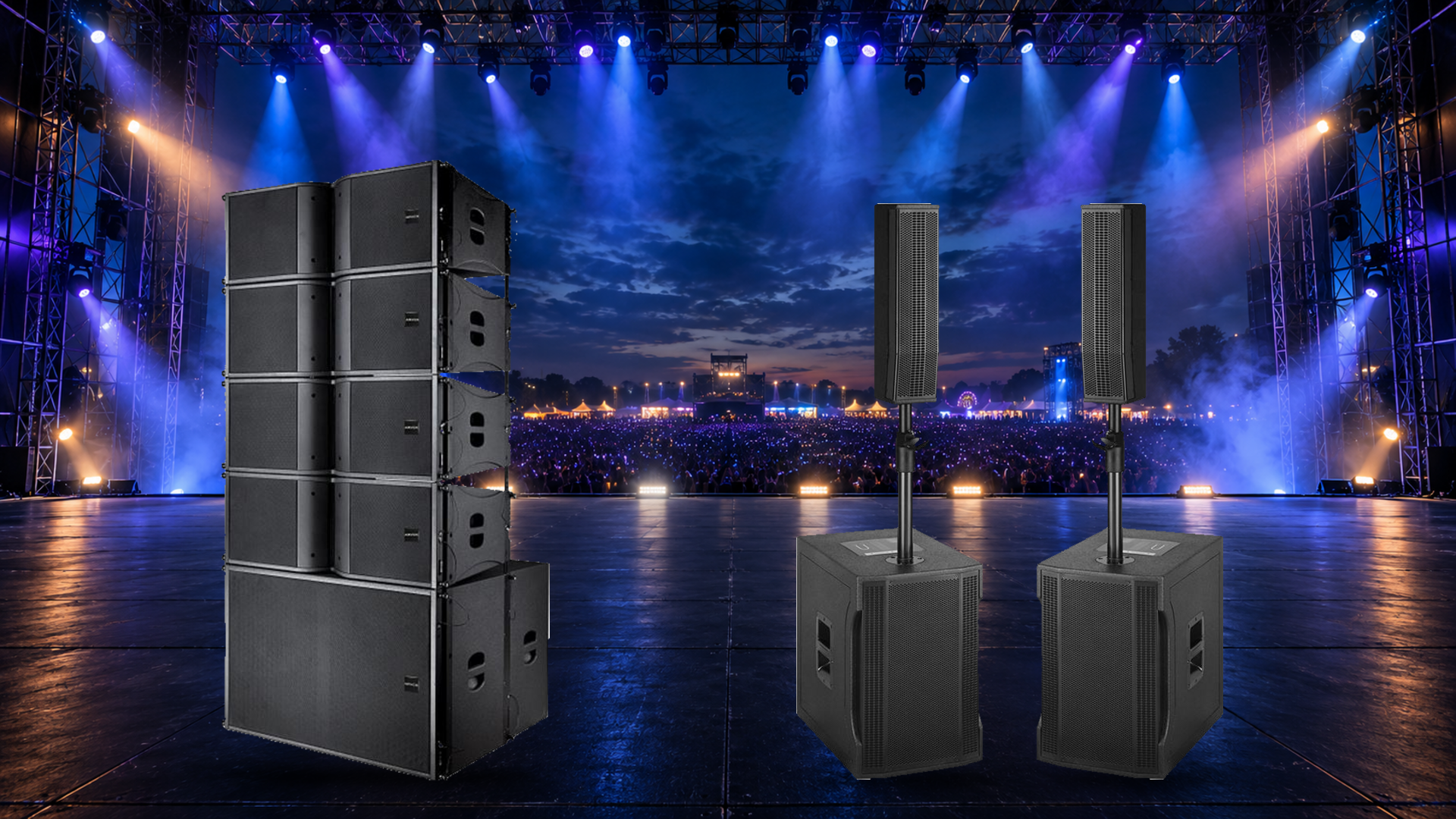
Neither is automatically better sounding. Also ask whether point-source loudspeakers, columns or a line array suit the audience geometry. An array is not an automatic upgrade for every room.
Architecture reference: Yamaha’s amplifier and powered-speaker guide.
04 / Match the whole signal path
- 01SourcesMicrophones & playback
- 02Mix & processMixer / system DSP
- 03AmplifyExternal or built in
- 04ReproduceMains / subs / fills
- Passive loads: confirm speaker impedance, wiring and the amplifier’s permitted load. Compare amplifier ratings under stated test conditions and use the loudspeaker maker’s matching guidance.
- Protection: request documented crossover, high-pass and limiter settings for the exact combination. Avoid a universal “double the watts” rule.
- Low-frequency needs: specify the programme before adding subs. Bass-heavy music and speech-led use have different priorities.
- Complete connections: list mixer inputs, monitor mixes, DSP outputs, connectors, cable lengths and power distribution.
Suspended equipment needs approved hardware and a qualified rigging/structural assessment. Do not infer safe mounting or outdoor suitability from a promotional image.
05 / Compare what the quotation actually includes
A low equipment total can omit work needed to make the system usable. Send every supplier the same brief and compare the scope line by line.
- Supply: itemized equipment, approved accessories, cables, cases and explicit exclusions.
- Delivery: confirmed lead time, shipping terms, destination and responsibility for import costs.
- Handover: installation scope, tuning, operator training, presets and documentation.
- Support: written warranty terms, spare-part availability and who handles a fault in your market.
For distribution or OEM/ODM enquiries, also specify forecast quantities, branding and packaging requirements, required market documentation and sample-approval steps. Confirm availability rather than assuming every model supports customization.
What should an acceptance check cover?
Walk the agreed front, middle and rear listening positions with speech and representative music. Check clarity, level consistency, noise, microphone stability and routing. Agree measurable criteria before ordering; record final settings and train the operator. This checklist does not replace professional system commissioning.
06 / Turn your venue details into a useful enquiry
You do not need to select model numbers first. Start with these details:
- Country, venue use, indoor/outdoor conditions and installation date.
- Dimensioned plan, ceiling height, photos, seating and audience depth.
- Speech/music programme, sources, monitors and existing equipment.
- Power, cable routes, mounting restrictions and operator experience.
- Budget range, quantities, delivery and service expectations.
Send your completed brief and room plans to gloria@arvox-tech.com to discuss an ARVOX proposal. Ask for the exact product datasheets and an itemized quotation.
Common questions
How many watts do I need for my venue?
There is no reliable watts-per-person shortcut. Programme, audience distance, loudspeaker performance and room conditions matter. Ask for a system proposal against your venue brief, not a wattage-only bundle.
Do I need a line array?
Not necessarily. Ask the supplier to explain why the proposed format fits the coverage, mounting and operating constraints. Compare it with an appropriate point-source option rather than choosing by appearance.
Can I use the same system indoors and outdoors?
Only after checking the specific products, environmental ratings, weather protection, safe deployment and electrical arrangements. An indoor event system is not automatically suitable for rain, dust or permanent outdoor use.
Should I buy the speakers and amplifier separately?
You can, but require written compatibility and processing guidance for the exact combination. A complete matched quotation makes responsibilities easier to define; it still needs venue-specific design and commissioning.
Sources & scope
Published 17 September 2026 using manufacturer educational resources. This is a procurement guide, not a model-specific specification or engineering design. ARVOX model capabilities, certifications and supply terms must be confirmed separately.